What if a Family Member Is an Animal Hoarder
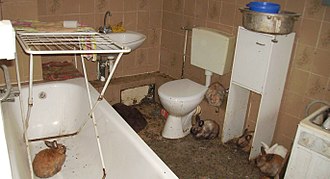
Animal hoarding of rabbits
Brute hoarding, sometimes called Noah syndrome,[1] is keeping a higher-than-usual number of animals equally domestic pets without power to properly house or care for them, while at the same fourth dimension denying this inability. Compulsive hoarding can exist characterized as a symptom of mental disorder rather than deliberate cruelty towards animals. Hoarders are deeply fastened to their pets and find it extremely hard to permit the pets become. They typically cannot comprehend that they are harming their pets by failing to provide them with proper intendance. Hoarders tend to believe that they provide the correct amount of intendance for them.[2] The American Society for the Prevention of Cruelty to Animals provides a "Hoarding Prevention Team", which works with hoarders to help them accomplish a manageable and healthy number of pets.[three]
Characteristics of a hoarder [edit]
An animal hoarder keeps an unusually large number of pets for their premises, and fails to treat them properly. A hoarder is distinguished from an animal breeder, who would have numerous animals equally the primal component of their business; this stardom can be problematic, yet, equally some hoarders are former breeders who take ceased selling and caring for their animals, while others will claim to be breeders as a psychological defense machinery, or in hopes of forestalling intervention. Gary Patronek, director of the Centre for Animals and Public Policy at Tufts Academy, defines hoarding as the "pathological human behavior that involves a compulsive need to obtain and control animals, coupled with a failure to recognize their suffering".[iv] According to another study, the distinguishing characteristic is that a hoarder "fails to provide the animals with adequate food, water, sanitation, and veterinary care, and... is in deprival most this inability to provide adequate intendance."[five] Along with other compulsive hoarding behaviors, it is linked in the DSM-IV to obsessive compulsive disorder and obsessive compulsive personality disorder.[vi] The DSM-five includes a diagnosis of hoarding disorder.[7]
Alternatively, animal hoarding could be related to addiction, dementia, or even focal delusion.[5]
The number of animals involved solitary is non a formative factor in identifying hoarding. Instead, the issue is the owner's disability to provide care for the animals and the owner's refusal to acknowledge that both the animals and the household are deteriorating.[eight] For example, in ane animal hoarding case, 11 cats were seized from a trailer.[9] The deputy police force officer testified that the trailer smelled and then strongly of feline waste that despite suffering from severe congestion at the fourth dimension of the investigation, she had a hard time staying in in that location for more than a few minutes.[ix] The deputy further testified that she could not step anywhere in the trailer without stepping on fresh, sometime, or smeared fecal thing, and that even the stove and sink were filled with bio-hazardous waste.[nine] Withal, a Canadian woman, who died leaving 100 properly fed, spayed/neutered, vaccinated, and clean-cut cats, was not considered an beast hoarder because her animals were properly cared for.[ten]
The Hoarding of Animals Research Consortium (HARC) identifies the following characteristics equally common to all hoarders:
- Accumulation of numerous animals, which has overwhelmed that person's ability to provide fifty-fifty minimal standards of nutrition, sanitation, and veterinary care;
- Failure to acknowledge the deteriorating condition of the animals (including disease, starvation, and even death) and the household environment (severe overcrowding, very unsanitary conditions); and−
- Failure to recognize the negative effect of the collection on their own wellness and well-being, and on that of other household members.[viii]
Compulsive hoarding tin be characterized every bit a symptom of mental disorder rather than deliberate cruelty towards animals. Hoarders are deeply fastened to their pets and discover it extremely difficult to allow the pets go. They typically cannot comprehend that they are harming their pets by failing to provide them with proper care. Hoarders tend to believe that they provide the right amount of care for their pets.[two] The American Society for the Prevention of Cruelty to Animals provides a "Hoarding Prevention Team", which works with hoarders to help them attain a manageable and healthy number of pets.[three]
Legal solutions [edit]
United states [edit]
Animal cruelty statutes [edit]
In the United States, creature hoarders can be prosecuted nether country animal cruelty laws for declining to provide a certain level of care to their animals.[eleven] The following provides some examples of the standards currently in effect. In Alaska, the cruelty statute defines a minimum standard of treat animals that includes (1) food and water sufficient to maintain each animal in good health; (2) an surround compatible with protecting and maintaining the practiced health and safety of the creature; and (three) reasonable medical care at times and to the extent available and necessary to maintain the animal in good health.[12] Also, in Colorado, a person commits cruelty to animals if he or she knowingly, recklessly, or with criminal negligence deprives an animal of necessary sustenance, neglects any animal, allows the creature to be housed in a manner that results in chronic or repeated serious physical harm, or fails to provide the animate being with proper food, beverage, or protection from the weather consequent with the species, breed, and blazon of animal involved.[13] In Colorado's animal cruelty statute, "neglect" means failure to provide food, water, protection from the elements, or other care more often than not considered to be normal, usual, and accepted for an fauna'due south health and well-beingness consistent with the species, breed, and blazon of beast.[xiv]
Since failure to provide proper care for animals is an human activity of omission or neglect rather than an affirmative human action, the failure to care for an fauna is considered a misdemeanor crime in most states.[11] For instance, in Alaska, if an creature owner fails to provide the aforementioned standards of care, the country has prima facie evidence of a failure to treat an beast.[15] If the prosecutor can bear witness the owner'southward failure to intendance for an brute was done with criminal negligence and the failure to treat the animal caused its death or astringent physical pain or prolonged suffering, then the possessor may be guilty of a Grade A misdemeanor.[xvi] In Colorado, failure to provide an animate being with the proper standard of intendance is a Class one misdemeanor.[17] In Virginia, each owner must provide for each of his companion animals: adequate feed; adequate water; acceptable shelter that is properly cleaned; adequate space in the main enclosure for the particular blazon of animate being depending upon its age, size, species, and weight; acceptable do; adequate intendance, treatment, and transportation; and veterinary intendance when needed to prevent suffering or disease transmission.[18] Violation of these standards is a Class 4 misdemeanor.[18] A second or subsequent violation may result in a higher grade misdemeanor.[xviii] Likewise, nether Virginia'southward animal cruelty statute, any person who deprives whatsoever animal of necessary food, potable, shelter or emergency veterinary treatment is guilty of a Class 1 misdemeanor.[19]
All the same, some states, like California and New Hampshire, may provide felony provisions for depriving an fauna of necessary sustenance, beverage, and shelter.[twenty] [21] In Colorado, information technology is a form 6 felony upon a second or subsequent conviction of animal cruelty.[13] In Maine, a person who is guilty of cruelty to animals may face criminal or civil charges at the discretion of the state'south attorney.[22]
Penalties under state animal cruelty statutes [edit]
Penalties for failing to provide proper intendance or medical care to animals under state animal cruelty statutes can include fines, creature forfeiture, the cost of care for the seized animals, and jail time.[11] Since animate being hoarding is sometimes associated with mental illness, a state of affairs may arise when an alleged animal neglecter is found incompetent to stand trial due to a mental disability and thus remains the rightful owner of the animals he or she has neglected (i.eastward. the animals were non forfeited). In the Matter of a Protective Club for Jean Marie Primrose, for example, after a tip from a veterinarian, police confiscated 11 cats from a adult female's feces and urine covered, rat infested trailer in Oregon; the cats were then placed in the intendance of a rescue organization. The woman was charged with criminal second degree animal neglect. After being diagnosed with a mild case of mental retardation, however, the judge constitute the woman unable to assist and assist in her ain defense. The 2d degree charge was thereby dismissed. Since the woman was not convicted of a crime, her rights to the 11 cats were not forfeited. Notwithstanding, from the time the cats were seized to the fourth dimension of the dismissal, the rescue system accrued more than than $30,000 in cat care fees. The rescue arrangement therefore placed a lien on the cats, significant the woman could not get her cats back until she paid off her debt. After the dismissal of the case, nonetheless, the adult female never made any try to contact the rescue arrangement nearly returning her cats. The fate of the cats therefore remained in limbo. The rescue organization could accept either kept the cats and kept accruing care fees considering not being rightful owners, they could not place the cats into homes, or forgiven the debt and returned the cats to the woman. Since the rescue organization felt the woman was incapable of adequately caring for the cats and since the organization did not desire to invest more coin that would likely remain uncompensated, the organization filed a petition for a express protective lodge as a fiduciary for the intendance and placement of the cats. The probate court ruled against organisation, but the appeals court overturned the lower courtroom'south order and held that the probate court did indeed have authority to enter a express protective gild nether ORS 125.650 as a "fiduciary necessary to implement a protective gild." The probate courtroom, then, granted the limited protective club and the organization was immune to identify the cats into new homes.[23] This example was considered a landmark past the Animal Legal Defense Fund.[24]
In add-on to jail time, creature forfeiture, and fines, a state, such as California, may allow courts to order psychological counseling at the court'due south discretion or may require the defendant to undergo anger management, such as the instance in Colorado.[11] Prosecutors may also be able to request bans on future pet ownership or request limits on the number of animals a convicted hoarder may go along.[11] For instance, in ALDF v. Conyers, over one hundred dogs and nine birds were confiscated from the defendants' domicile.[25] Virtually 70 of those dogs had severe oral illness, disintegrating jaws, and scarred corneas. One dog, who was caged in the basement, could barely stand upward and kept soiling himself, which pb to his skin being scalded from the urine and feces.[25] An officer too noticed the dog'southward tongue hanging out of his mouth, but later learned that his tongue was sticking out because his jaw had disintegrated.[25] The Animal Legal Defense Fund moved for a permanent injunction to enjoin defendants from owning animals from the date of the court's terminal judgment to 10 years.[25]
Criticism of applying animal cruelty laws to hoarding [edit]
Although animal hoarders can exist prosecuted under state fauna cruelty laws, many scholars maintain that basic brute cruelty laws are inefficient in prosecuting hoarders.[11] As Stephan Otto, managing director of legislative affairs for the Animate being Legal Defense Fund explains: "Only a scattering of states let felony charges for the worst kinds of beast neglect . . . They also need stronger laws that take into account when multiple numbers of animals were in involved in a case."[11] HARC'south research on 56 beast hoarding cases illustrates Otto's point:
In 16 cases, individuals were charged with one count of animal cruelty for their unabridged group of animals rather than one count of cruelty for each animal involved. In several other cases, hoarders were only charged with one count of failure to license or provide a rabies vaccination when there were dozens of animals involved.[eleven]
Prosecutors and judges, all the same, discourage multiple charges, believing that they "clog" the organisation. The difficulty of proving each accuse also accounts for this discouragement.[11] In order to bring one charge of cruelty for each animal, prosecutors and animal agencies must provide proof of cruelty to each animal, matching each brute with its count number.[11] Charging the hoarder with only one count reduces the burdens on the organisation, the prosecutors, and the brute agencies, just undermines the severity of the charges.[xi]
Hoarding-specific laws [edit]
Only two states take laws regarding the hoarding of animals: Illinois and Hawaii.
Passed in 2001, the Illinois Humane Intendance for Animals Act was amended to include a definition a companion animal hoarder and mandated psychological counseling for animal hoarders who violate Section iii.[xi] A person convicted of violating section three of the Human action (which requires the provision of food and h2o, adequate shelter and protection from the weather, veterinary care, and humane care and treatment) is guilty of a misdemeanor with a second or subsequent violation raising the offense to a Class iv felony.[11] Ane commentator, Victoria Hayes, JD, believed that although Illinois' legal definition of a "companion animal hoarder" is a stride in the right direction, the definition does non provide any actress tools to a prosecutor.[11] Creature hoarding itself is not prohibited past the statute, she said, and the prosecutor must still show a violation of Section 3 of the Humane Intendance for Animals Act. It is of import to note that animal hoarding itself is non prohibited past the Illinois statute.[11]
Hawaii, on the other hand, specifically outlaws brute hoarding. In 2008, animal hoarding became a misdemeanor offense. Hawaii'due south Penal Code now provides:
(1) A person commits the offense of animal hoarding if the person intentionally, knowingly, or recklessly;
- (a) Possesses more than than fifteen dogs, cats, or a combination of dogs and cats;
- (b) Fails to provide necessary sustenance for each dog or cat; and
- (c) Fails to correct the weather condition under which the dogs or cats are living, where conditions injurious to the dogs', cats', or possessor's health and well-existence upshot from the person's failure to provide necessary sustenance.
(ii) Animal hoarding is a misdemeanor.[26]
Hawaii's law specifically criminalizes hoarding, while depriving an animal of necessary sustenance can also found a separate offense of animal cruelty. The hoarding police differs from ordinances that limit the number of pets a person tin have because it only prohibits keeping more than fifteen dogs and cats if the owner fails to provide necessary care for the animals and that failure causes injury to the animals or the possessor.[eleven]
An important aspect of the law is that prosecutors may exist able to charge hoarders with one count of beast hoarding that covers all of the animals.[xi] When hoarding is prosecuted nether state animate being cruelty laws, prosecutors must charge hoarders with multiple counts of animal cruelty—one for each animate being on the premises.[xi] By creating the criminal offense of "hoarding", Hawaii's law seems to let prosecutors to charge hoarders with one count of animal hoarding that covers every animal the person has hoarded, easing the prosecution'southward burden of providing documentation of each individual animal's injury.[11] This volition also decrease the cumbersome brunt multiple charges can place on courts.[11] Prosecutors will as well be able to bring separate charges of animal cruelty for individual animals whose injuries are easiest to document.[xi]
Hawaii's statute does not mandate psychological counseling for convicted hoarders or restrict future animal ownership.[11]
Anti-hoarding legislation has been proposed, only not passed, in several other states.[27]
Hoarding-specific municipal ordinances [edit]
While a state may not have an brute hoarding specific statute, its municipalities may have animate being hoarding specific ordinances. For case, the city of Alto, Georgia's ordinance specifically prohibits hoarders.[28] The ordinance defines a hoarder as a person or entity that:
(a) Collects animals and fails to provide them with humane/adequate care;
(b) Collects dead animals that are not properly disposed of equally required by this article; or
(c) Collects, houses, or harbors animals in filthy, unsanitary conditions that constitute a health adventure to the animals being kept, and/or to the animals or residents of adjacent property.
[28]
If a person is convicted of being a hoarder under this ordinance, that person may not own, possess, or have on his bounds in Alto any animate being for one year from the appointment of confidence. The person may as well be punished by a fine not to exceed $1,000.00 and/or past imprisonment in the common jail of the town not to exceed half dozen months. [28]
The Animal Law Coalition has a Model Animate being Hoarding Specific Ordinance (available under "Resources" at its website) that can be adapted past various communities.[29]
More than controversially, a municipality may limit the number of pets a person is allowed to keep in his or her dwelling house in hopes of preventing animal hoarding. These are called pet limitation ordinances. Gary J. Patronek, in The Problem of Fauna Hoarding, Municipal Lawyer 6 (2001), stated that pet limitation ordinances are "wildly unpopular, difficult to enforce, and likely to be opposed past a broad coalition of pet fanciers, breeders, rescue groups, and animal protection organizations." While a hoarding specific ordinance, like Alto, prohibits keeping numerous animals in conditions that are harmful to the animals' health, pet limitation ordinances simply prohibit keeping more than than a certain number of animals regardless of the level of care provided to the animals.[eleven] Equally mentioned previously in this article, the number of animals involved alone is not a determinative factor in identifying hoarding and information technology is possible for a person to successfully care for a large number of animals. Examples of pet limitation ordinances include: Aurora, Colorado and Banks County, Georgia.[thirty] [31] In Banks County, Georgia, the number of dogs a person can own differs based on the zone in which the person's property is located.
Some pet limitation ordinances, however, provide exemptions to the pet restrictions. For case, in Great Falls, Montana, a person who owns or harbors any more than than the number of dogs and cats permitted by the ordinance for a menses of more than xxx (30) days must obtain a multiple creature allow. Additionally, a breeder can be exempt from the ordinance by obtaining a Multiple Animal Hobby Breeder Permit. These exemptions are, no doubtfulness, provided to lessen the opposition and problems of pet limitation ordinances.[32]
Problems with prosecuting hoarders [edit]
Prosecuting animal hoarding cases is "circuitous, time consuming, and plush; as made evident in the Primrose example, the high cost of caring for animals rescued from hoarders, who ofttimes must be cared for at the rescuer'due south expense, is a huge disincentive for prosecuting these types of cases. Especially since the beast rescue operation may never be compensated for its expenses. Further, every bit Dr. Gary Patronek explains, "[p]rosecutors don't really take the tools they demand to fully go after these cases . . . and they oft don't have the back up of other agencies that they demand."[11] This lack of communication among various governmental agencies, such equally code enforcement, the wellness department, and animal command, impedes the detection of animal hoarders and thereby the prosecution of hoarders.[11] Further, since animal hoarding cases do not get widespread attention, they do non garner community support, which is likewise a disincentive for prosecution.[11] Additionally, officials may opt to forgo charges or enter into lenient plea-bargains in substitution for custody of the animals because they fear that the animals will languish in shelters while prosecution is pending.[11] These attempts to "strike a balance between helping both the hoarder and the animals involved" are generally ineffective because of high backsliding rates amongst hoarders.[11] When hoarders are prosecuted, there is wide inconsistency in the number and severity of charges brought.[xi] These inconsistencies may arise because some prosecutors and judges discourage multiple charges, assertive that they "clog" the system.[11] The difficulty of proving each accuse also accounts for these inconsistencies. In order to bring one charge of cruelty for each animate being, prosecutors and creature agencies must provide proof of cruelty to each animal, matching each beast with its count number.[11] Adversely, charging the hoarder with only 1 count reduces the burdens on the organization, the prosecutors, and the animate being agencies, simply undermines the severity of the charges.[11] Laws that create a dissever crime of animal hoarding may solve this problem past allowing one count of hoarding to be brought in every case that encompasses the hoarding aspect of the accuse rather than focusing on each private count of cruelty.[11]
United Kingdom [edit]
In the Great britain, an RSPCA spokeswoman said the society was candidature for legislation to monitor people who take in large numbers of animals.[33]
Dangers [edit]
The wellness issues in animal hoarding encompass a variety of concerns related to both individual and public wellness. Animal hoarding is the cause of many severe health risks that threaten the hoarded animals, individuals living in hoarding residences, and surrounding neighbors.
Health effects on animals [edit]
Due to the harmful effects on the health of the animals involved, animal hoarding is considered a class of cruelty to animals.[4] Hoarders frequently fail to provide bones intendance for their animals, thus resulting in disease and often death. The primary beast health issues involved are malnourishment and problems related to overcrowding and neglect. Consequences of hoarding are long-lasting and continue to affect the animals even after they have been rescued and provided with better care.[5]
Malnourishment [edit]
Lack of sufficient food and water is a common characteristic of hoarding situations. The immediate effect of this is starvation and death.[iv] Ane written report found at least one dead animate being present in over half of examined cases, the leading crusade of expiry beingness an insufficient food and water supply.[34] Malnourishment also leads to increased susceptibility to affliction, and the hoarded animals are often in advanced stages of sickness.[34] Furthermore, when at that place is a limited nutrient supply, animals may resort to aggressive behavior in competing for available food, killing and sometimes even eating other animals.[35]
Overcrowding [edit]
Overcrowding also leads to acute animal wellness problems in hoarding situations. The number of animals found in hoarding cases range from dozens to several hundreds, with extreme cases involving over a thousand animals. Animals are confined to houses, apartments, or trailer-homes.[34] In one case, 306 cats were removed from a home, 87 of which were dead. Corpses were found embedded in the chimney and living room furniture.[4] In addition to lack of living space, overcrowding facilitates the spread of diseases amidst animals.[35] Furthermore, in cases where more 1 species is bars to the same living infinite, animals can pose a danger to one other due to inter-species aggression.[36]
Owner neglect [edit]
Diverse other wellness problems arise from hoarders' neglect of the animals and inability to provide basic treat them. Lack of veterinary attention is notable among these. Hoarders, refusing to admit the deteriorating wellness conditions of their animals and scared they will exist forced to give up custody, often decline to take their animals to veterinarians.[5] As a result, diseases are left untreated and allowed to become more astringent. Another problem tied to neglect is poor sanitary conditions for the animals. Basic animal waste matter management is absent in virtually all animal-hoarding situations, and animals are filthy and often infected with parasites as a result.[35] Furthermore, animals suffer behaviorally from a lack of socialization caused by an absence of normal interaction with other animals.[five]
Lasting consequences [edit]
Many of these wellness problems go along to cause suffering fifty-fifty after the animals are rescued. Strained animal shelters or humane societies, forced to prioritize when dealing with numerous rescued animals, may be unable to provide immediate treatment to many animals.[36] Furthermore, many of the rescued animals, due to wellness or behavioral issues, may not exist suitable for adoption.[5] Euthanasia, even in cases where the animals are non beyond rehabilitation, is often the simply option for rescued animals.[36] The effects of hoarding on the health and socialization of the animals involved are severe and lasting, taking heavy tolls on both their physical and psychological well-being.
Wellness effects on humans [edit]
Animal hoarding besides causes many health bug for the people involved. Hoarders, by definition, neglect to correct the deteriorating sanitary atmospheric condition of their living spaces, and this gives rise to several wellness risks for those living in and effectually hoarding residences.[4] Beast hoarding is at the root of a string of human health bug including poor sanitation, fire hazards, zoonotic diseases, envenomation, and fail of oneself and ane's dependents.
Sanitation concerns [edit]
Poor sanitation practices, a general characteristic of hoarding households, pose health risks to both animals and humans. In typical hoarding residences, animate being waste product is establish blanket interior surfaces, including beds, countertops, and cupboards.[37] In 1 instance, floors and other surfaces were constitute to be covered in a six-inch layer of feces and garbage.[iv]
In improver to astringent odors which may pose a nuisance to neighbors, creature waste matter poses serious health risks through both the spread of parasites and the presence of noxious ammonia levels.[35] OSHA, the United States bureau regulating air quality standards in work-related environments, has identified an ammonia level of 300 parts per million as life-threatening for humans;[5] in many hoarding cases the atmospheric ammonia level in the housing infinite approaches this number,[36] requiring the use of protective vesture and breathing apparati during inspections or interventions.[37] In an extreme case, the ammonia level in the hoarder's house was 152 parts per million even subsequently ventilation.[5]
The presence of animal waste also prevents sanitary storage and preparation of food, which puts residents at risk of contracting food-related illnesses and parasites.[37] Insect and rodent infestation tin both follow and worsen hoarding conditions, and tin can potentially spread to the surrounding environment including to nearby buildings.[36] In one case, an uncomplicated schoolhouse had to be shut downwards due to a flea infestation that had spread from a nearby dog hoarder residence.[37]
Hoarders are ofttimes constitute to collect large numbers of inanimate objects in add-on to animals,[34] giving ascension to ataxia as well. Hoarded objects tin can include newspapers, trash, clothing, and food; the clutter inhibits normal motion around the house, hampering household maintenance and sanitary food preparation, heightening the adventure of accidents, and contributing to the overall level of squalor.[34] A lack of functioning toilets, sinks, electricity, or proper heating (oftentimes due to hoarders not paying bills, though poor maintenance may besides be a cause) further exacerbates the problem.[37] Fire hazards contain yet another health consequence tied to poor sanitation;[37] the ataxia found in many hoarding households prevents workable burn escape plans and serves as possible fuel when located close to oestrus sources. The risk is amplified when hoarders, due to inoperative heating systems, seek alternating heating methods such as fireplaces, stoves, or kerosene heaters.[37] [38]
Zoonotic diseases [edit]
Another human health issue caused by beast hoarding is the adventure of zoonotic diseases. Defined equally "human diseases acquired from or transmitted to whatsoever other vertebrate animal",[39] zoonotic diseases can often be lethal and in all cases constitute a serious public wellness business organisation. Examples of well-known zoonotic diseases include bubonic plague, influenza, and rabies.[40] Common domesticated animals institute a large portion of animals carrying zoonoses,[39] and equally a upshot, humans involved in beast hoarding situations are at particular run a risk of contracting disease.[34] Zoonoses that may ascend in hoarding situations—through vectors such as dog, cat, or rat bites—include rabies, salmonellosis, catscratch fever, hookworm, and ringworm.[41] I zoonosis of special concern is toxoplasmosis, which tin can be transmitted to humans through cat feces or badly-prepared meat, and is known to cause astringent birth defects or stillbirth in the case of infected meaning women.[42] The hazard of zoonotic diseases is amplified by the possibility of community epidemics.
Cocky-neglect and child/elder abuse [edit]
The problems of self-neglect and elder and kid abuse are also health issues associated with creature hoarding. Cocky-neglect can be defined every bit "the inability to provide for oneself the goods or services to meet basic needs", and has been shown to be an "independent adventure factor for decease".[43] While self-neglect is a status generally associated with the elderly, creature hoarders of any age can and do suffer from it.[37] This is demonstrated by the fact that hoarders' lifestyles oft match the degenerate sanitary conditions that environs them. Kid and elderberry corruption arise when dependents are living with the hoarder. Co-ordinate to ane study, dependents lived with hoarders in over half of the cases.[v] Equally with his or her animals, the hoarder frequently fails to provide adequate intendance for dependents both young and erstwhile, who endure from a lack of basic necessities too as the health problems caused by unsanitary weather condition.[34] In one case, two children of a couple hoarding 58 cats and other animals were forced to repeat kindergarten and starting time grade because of excessive absence due to respiratory infections.[37] Self-fail and neglect of dependents make up a major human health concern of animal hoarding.
Mental health issues [edit]
Testify suggests that there is "a strong mental wellness component" in fauna hoarding, though information technology has not been firmly linked to whatsoever specific psychological disorder.[38] Models that have been projected to explain brute hoarding include delusional disorder, zipper disorder, obsessive–compulsive disorder, zoophilia, dementia, and habit.[44] Direct evidence for most is lacking, however.[37]
Delusional disorder [edit]
Animal hoarders display symptoms of delusional disorder in that they have a "belief system out of touch on with reality".[38] Virtually all hoarders lack insight into the extent of deterioration in their habitations and on the health of their animals, refusing to acknowledge that anything is wrong.[37] Furthermore, hoarders may believe they have "a special ability to communicate and/or understand with animals",[44] rejecting any offers of assistance. Delusional disorder is an effective model in that information technology offers an explanation of hoarders' apparent blindness to the realities of their situations.
Attachment disorder [edit]
Another model that has been suggested to explicate beast hoarding is attachment disorder, which is primarily caused by poor parent-child relationships during childhood. It is characterized past an disability to form "shut relationships [with other humans] in adulthood".[44] As a result, those suffering from attachment disorder may turn to animals for companionship. Interviews with fauna hoarders have revealed that hoarders have oftentimes experienced domestic trauma in childhood, which is the footing of the evidence for this model.[44]
Obsessive–compulsive disorder [edit]
Possibly the strongest psychological model put forrad to explain animal hoarding is obsessive–compulsive disorder (OCD). An overwhelming sense of responsibility for something is characteristic of people with OCD, who then accept unrealistic measures to fulfill their perceived duty. Animal hoarders often feel a strong sense of responsibility to take care of and protect animals, and their solution—that of acquiring as many animals equally they perchance can—is unrealistic.[44] Further, the hoarding of inanimate objects, practiced by a bulk of animate being hoarders,[37] is a adequately common occurrence in people with OCD.[44] These connections between animal hoarding and obsessive–compulsive disorder advise that OCD may be a useful model in explaining animate being hoarding behavior.[44] However, this theory has besides been refuted past some; Dr. Akimitsu Yokoyama theorizes that animal hoarding could exist explained using Asperger syndrome.[45]
Popular culture and fiction [edit]
- On the Animal Planet TV series Confessions: Beast Hoarding, friends and family of animate being hoarders intervene to offer them back up to make a alter in the form of psychological aid and veterinarian care or placement for their pets.
- In the blithe series The Simpsons, fauna hoarding is represented by the semi-recurring graphic symbol Crazy Cat Lady Eleanor Abernathy. She is a mentally sick onetime woman covered by cats, who is often seen speaking in gibberish and throwing cats at people.
- In Ann Bannon'due south novel Journey to a Woman, Vega's female parent and grandfather own an excessive number of cats and could be considered to be animal hoarders.
- In webtoon Lookism, an arc featuring an creature hoarder who nabbed both Daniel Park and Johan Song's dogs.
Run into as well [edit]
- Cat lady
- Compulsive hoarding
- Geriatric medicine
- Monomania
References [edit]
- ^ Saldarriaga-Cantillo, Alejandra, and Juan Carlos Rivas Nieto (2015). "Noah syndrome: a variant of Diogenes syndrome accompanied by animal hoarding practices". Journal of Elder Corruption & Neglect. 27 (3): 270–275. doi:10.1080/08946566.2014.978518. PMID 25397353. S2CID 3828174.
{{cite journal}}: CS1 maint: multiple names: authors list (link) - ^ a b Davis, Susan; Flaherty (illus), Jake (2002). "Prosecuting Creature Hoarders is similar Herding Cats" (PDF). California Lawyer (September): 26, 28, 29, 67. Archived from the original (PDF) on July iii, 2004.
- ^ a b Hoarding of Animals Research Consortium (HARC) (2004). "Normally asked questions nigh hoarding". Archived from the original on 2010-01-12.
- ^ a b c d e f Patronek, Gary J. (2006). "Beast hoarding: its roots and recognition". Veterinary Medicine. 101 (eight): 520–530.
- ^ a b c d e f one thousand h i Berry, Colin; Patronek, Gary; Lockwood, Randall (2005). "Long-Term Outcomes in Animal Hoarding Cases". Animal Police. 11: 167–194.
- ^ "Mental wellness bug and beast hoarding". Archived from the original on 2014-06-thirteen.
- ^ American Psychiatric Association (2013). Diagnostic and Statistical Manual of Mental Disorders (Fifth ed.). Arlington, VA: American Psychiatric Publishing. ISBN978-0-89042-555-8.
- ^ a b Hayes, Victoria (May 2010). "Detailed Discussion of Animal Hoarding". The Animate being Legal and Historical Center. Michigan State University College of Police. Retrieved 2014-04-08 .
- ^ a b c Leek Leiberan, Margaret H. (March 2006). "In the Affair of a Protective Guild for Jean Marie Primrose" (PDF). pleading . Retrieved 2014-04-08 .
- ^ Avery, Lisa (2011-04-xv). "From Helping to Hoarding to Hurting: When the Acts of "Skillful Samaritans" Become Felony Animal Cruelty". Valparaiso University Constabulary Review. 39 (4): 815–858.
- ^ a b c d e f g h i j 1000 l m due north o p q r south t u 5 w x y z aa ab air conditioning ad ae af ag Hayes, Victoria (2010). "Detailed Word of Animal Hoarding". The Animal Legal and Historical Society. Michigan State Academy Higher of Police. Retrieved 2014-04-12 .
- ^ "iii". ActNo. 03.55.100of2004 . Retrieved 2014-04-12 .
- ^ a b "18". ActNo. 18-nine-202of2012 . Retrieved 2014-04-12 .
- ^ "18". DeedNo. 18-9-201(four)of2012 . Retrieved 2014-04-12 .
- ^ "11". Human actionNo. 11.61.140(d)of2010 . Retrieved 2014-04-12 .
- ^ "eleven". ActNo. 11.61.140(a)(2)of2010 . Retrieved 2014-04-12 .
- ^ "18". Human activityNo. 18-9-202(2)(a)of2012 . Retrieved 2014-04-12 .
- ^ a b c "3.two". Article 2,ActNo. 3.2-6503of2003 . Retrieved 2014-04-12 .
- ^ "3.2". Article 9,ActNo. three.2-6570of2013 . Retrieved 2014-04-12 .
- ^ "14". Human activityNo. 597of2011 . Retrieved 2014-04-12 .
- ^ "LXII". ActNo. 644:8of2008 . Retrieved 2014-04-12 .
- ^ "seven". Human activityNo. 4016of2007 . Retrieved 2014-04-12 .
- ^ "In the Affair of a Protective Club for Jean Marie Primrose". The Animal Legal and Historical Center. Michigan State University College of Police force. 2005. Retrieved 2014-04-12 .
- ^ "Once Neglected, At present Protected – ALDF Wins Historic Ruling for Abused Animals". Creature Legal Defence force Fund. Animal Legal Defense Fund. 2007. Archived from the original on 2014-04-13. Retrieved 2014-04-12 .
- ^ a b c d "ALDF v. Conyers". The Animate being Legal and Historical Middle. 2007. Retrieved 2014-04-12 .
- ^ "37". ActNo. 711-1109.6of2009 . Retrieved 2014-04-12 .
- ^ ASPCA (2010). "Frequently Asked Questions About Animal Hoarding". ASPCA. ASPCA. Archived from the original on 2014-04-16. Retrieved 2014-04-12 .
- ^ a b c "Alto, Georgia Ordinance". Retrieved 30 Apr 2014.
- ^ "Brute Law Coalition".
- ^ "Aurora, Colorado Ordinance". Retrieved 30 Apr 2014.
- ^ "Banks County, Georgia Ordinance". Retrieved thirty April 2014.
- ^ "Great Falls, MontanaOrdinance". Retrieved 30 April 2014.
- ^ "Health: Pet hoarders may need assistance". BBC News. 1999-06-22. Retrieved 2010-01-01 .
- ^ a b c d e f thou Patronek, Yard J (1999). "Hoarding of animals: an under-recognized public health problem in a difficult-to-written report population". Public Health Reports. 114 (1): 81–87. doi:10.1093/phr/114.1.81. PMC1308348. PMID 9925176.
- ^ a b c d "The Hoarding of Animals Research Consortium (HARC)". Tufts University. Archived from the original on 2011-01-17. Retrieved 2007-12-07 .
- ^ a b c d e Patronek, Gary (18 November 2007). "Large calibration removal and rescue of animals" (PDF). Hoarding of Animals Enquiry Consortium. Tufts University. Archived from the original (PDF) on October 13, 2006.
- ^ a b c d e f m h i j k 50 Arluke, Arnie; et al. (May 2002). "Health Implications of Animal Hoarding". Wellness & Social Work. 27 (two): 125–136. doi:10.1093/hsw/27.2.125. PMID 12079167.
- ^ a b c Patronek, Gary (2001). "The Problem of Beast Hoarding" (PDF). Municipal Lawyer. 19 (6): vi–nine, 19.
- ^ a b "animal disease." Encyclopædia Britannica. 2007. Encyclopædia Britannica Online. 8 Dec. 2007 <http://search.eb.com/eb/commodity-63292>.
- ^ Terminal, Ed. John M. (2007). "zoonosis". A Dictionary of Public Health: Oxford Reference Online. Oxford University Printing.
- ^ John M. Last "animals as carriers of disease" The Oxford Companion to Medicine. Stephen Lock, John Yard. Last, and George Dunea. Oxford University Press 2001. Oxford Reference Online. Oxford University Press. Brigham Young Academy (BYU). 8 Dec 2007.
- ^ "toxoplasmosis" A Dictionary of Public Wellness. Ed. John K. Last, Oxford University Press, 2007. Oxford Reference Online. Brigham Young Academy. 8 December 2007.
- ^ Dyer, Carmel Bitondo; Goodwin, James South.; Pickens-Pace, Sabrina; Burnett, Jason; Kelly, P. Adam (September 2007). "Self-Fail Amidst the Elderly: A Model Based on More Than 500 Patients Seen by a Geriatric Medicine Team". American Journal of Public Wellness. 97 (9): 1671–1676. doi:x.2105/AJPH.2006.097113. PMC1963287. PMID 17666694.
- ^ a b c d e f grand Frost, Randy (2000). "People Who Hoard Animals". Psychiatric Times. 17 (iv).
- ^ Philips, Allie (2011). Defending the Defenseless: A Guide to Protecting and Advocating for Pets. Rowman & Littlefield Publishers. p. 125. ISBN9781442202146.
External links [edit]
- Confessions: Animate being Hoarding on Brute Planet
- Animal Hoarding documentary project
- Inside Animal Hoarding (with video)
- People Who Hoard Animals, Psychiatric Times
- Hoarding, Humane Guild of the Usa
- The Hoarding of Animals Research Consortium, Tufts University
- Animal Hoarding, American Society for the Prevention of Cruelty to Animals
- Animal Legal Defence force Fund
- Animate being Hoarding: Alone in a Crowded Room
- News and data on fauna hoarding and large scale creature cruelty
- Mary Chantrell, a Notorious 19th Century Cat Hoarder
sampsonblikerchims.blogspot.com
Source: https://en.wikipedia.org/wiki/Animal_hoarding
0 Response to "What if a Family Member Is an Animal Hoarder"
Post a Comment